WALK BACK IN TIME
A Developing Fern Walk for the Future
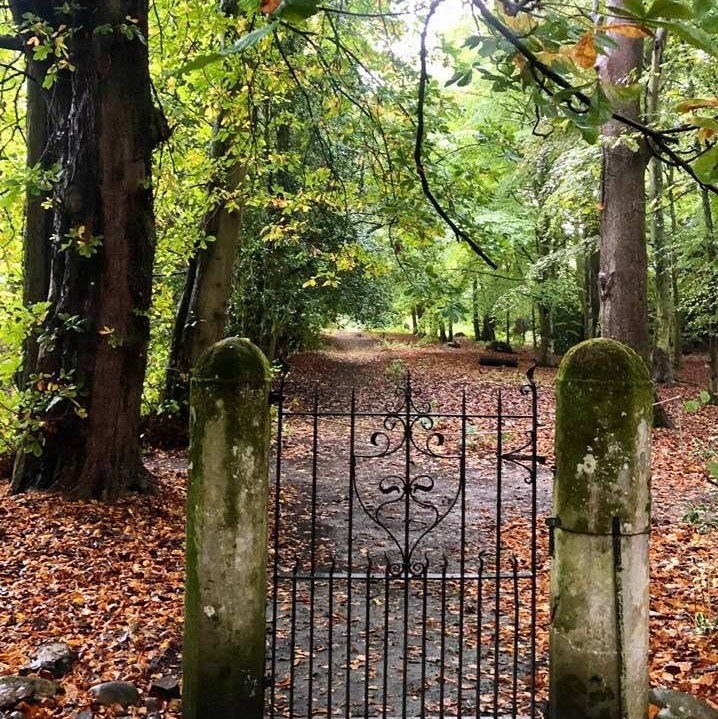
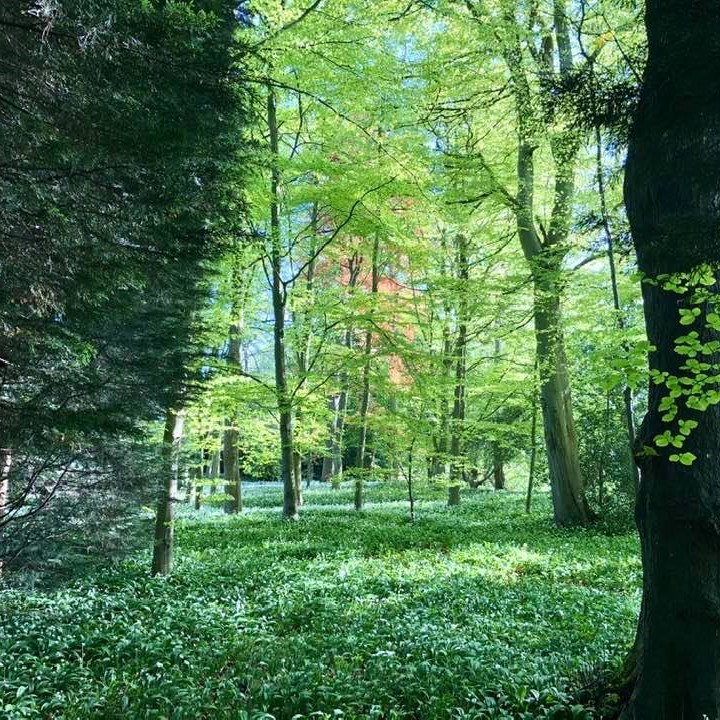
Take a peaceful stroll through the estate’s eastern woodland, where you can enjoy spring flowers, dappled summer shade, and colourful autumn leaves throughout the seasons. Here, you’ll also find the ruined tomb of the Covenanter, believed to be the final resting place of Sir James Scott and his wife Antonia Scott.
Woodland Walk
The woodland walk can be accessed from the south-east over a stone stile, followed by a second high stile (which can be challenging, particularly when wet). An alternative, more accessible route without stiles is available from the car park.
Along the path, you’ll encounter the 4th largest beech tree in Scotland (as listed in the Champion Tree Register), alongside ancient Sessile Oak trees, Ash trees, the ever-present Sycamore, and towering Scots Pine, among other native species. This established woodland supports an array of native wildlife, including butterflies, moths, and red squirrels. (See Duncan Davidson’s article, April 2021.)
Mosses, ferns, grasses, and other plants thrive in areas where lighter shade falls, populating the woodland floor. A new fern walk is currently being developed in collaboration with Heather McHaffie, a fern expert from the Royal Botanic Garden Edinburgh.
Well-behaved dogs on leads are welcome—please remember to clean up after your dog. (Thank you!)
The Tomb Wood
It is widely believed that Sir James Scott and Lady Antonia Scott are the two individuals buried in the small chapel located in the ‘Tomb Wood’ at Rossie. Lady Antonia Scott passed away at Rossie on May 18, 1663, and was buried there on May 27th, in daylight.
The chapel was excavated in 1937 in the presence of a local minister and doctor. During the excavation, a male and female skeleton were discovered buried side by side. After a brief examination and photographic record, the bodies were respectfully re-interred. While the remains could not be positively identified, it is widely assumed that they belong to Sir James Scott and Lady Antonia Scott.
Historical Background: Sir James Scott and Rossie Estate
Sir James Scott first appears in historical records with his acquisition of Rossie Estate, where he lived with his wife, Antonia Willobie (also known as Willoughby), and their two daughters, Mary and Anna. Little is known about Antonia, but Sir James is noted for his military career outside Scotland. He served as an officer in the Republic of Venice’s army during the Thirty Years War. He was also a Gentleman of the Bedchamber to King James I.
Sir James Scott was also involved in the funeral of the 1st Earl of Buccleuch on June 11, 1634, and was appointed Justice of the Peace for Fife on November 26, 1634, and again on November 11, 1635, alongside John Brown of Fordell, who succeeded him at Rossie. Colonel Sir John Brown fought with the Covenanter armies against the forces of King Charles I from 1644–1646.
In 1641, Sir James Scott was recorded in the Privy Council’s Rolls of Delinquents. He went on to command the left wing of the Covenanters army during the Battle of Tippermuir on September 1, 1644, where his forces were defeated by James Graham, 5th Earl and 1st Marquis of Montrose, who led the Royalist army. Though his side lost, Sir James distinguished himself in battle.
After this, Sir James Scott disappears from the records related to this campaign, although General Baillie is noted as pursuing Montrose’s army past Rossie and Lindores in July 1645. The Fife regiments under Baillie gathered at Rossie on August 13, 1645, before marching to participate in the Battle of Kilsyth on August 15, 1645, which was once again lost to Montrose.
Today, Rossie Estate is a peaceful haven, but it’s easy to imagine the action and noise that would have greeted visitors in July 1645.
Sir James Scott is last mentioned as residing at Rossie in February 1648, when a charter was issued conveying the estate to Sir John Brown upon his betrothal to his daughter Mary. A subsequent charter from 1653 confirms that Sir James Scott had passed away by that time.
Their daughter Mary first married a local gentleman who commanded a cavalry troop during the conflicts. Unfortunately, he died in Leith prison from fever following the defeat at Inverkeithing. Mary later married Colonel John Brown(e) of Fordell in the Parish of Arngask (Perthshire). Colonel Brown was a prominent member of the gentry, a Justice of the Peace colleague of Sir James in 1635, and a fellow officer in the Covenanter armies. She then married Richard Barclay, Laird of Collairnie, and finally William Muir, Laird of Rowallan. She passed away in 1706 and is buried in Greyfriars Kirk, Edinburgh.
Their other daughter, Ana, married Sir Robert Montgomerie of Skelmorlie. Antonia, another daughter of Sir John Brown, married the Laird of Dunlop in the same ceremony as her mother in Edinburgh in 1667.